GrassrootsPriorities.com is the website I built with the guidance and support of JoAnn Fleming and Robert Shulter. It was a monumental task that took the better part of three months (March to May 2023). It endeavored to bring to life and connect the dots given to us by the Texas Legisature Online.
Thankfully, it was well-received and very much used. Thousands and thousands of times you queried the website to learn about votes, legislators and committee testimony. I’m glad it helped.
We also saw the use of our map, your capture of the way we color code votes to make it easier to see, and your use of a legislator’s Quick Summary. A picture can truly be worth a thousand words.
But I learned some things in building the website, and I thought I would share that with you.
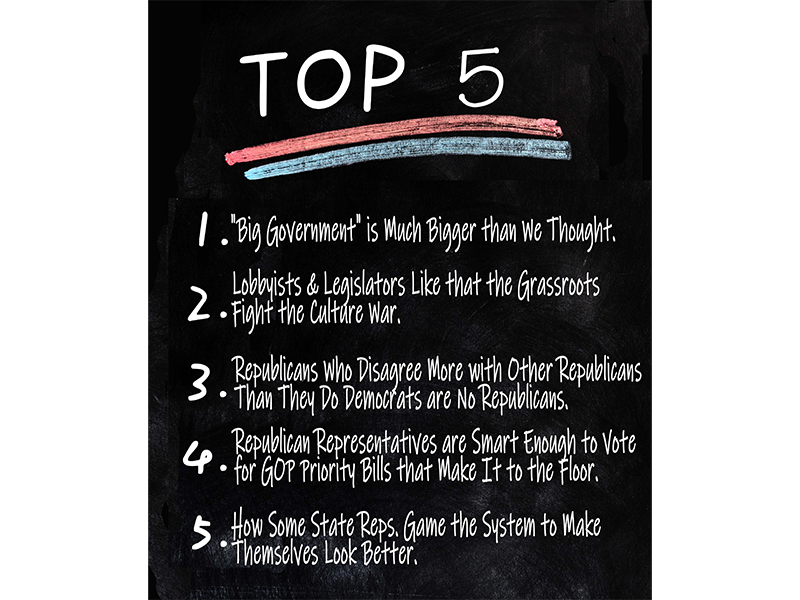
1. “Big Government” is Much Bigger than We Thought.
There’s a great meme that starts out asking “Should the government…” and then immediately moves to a big “NO!”
It’s funny and gets shared because it’s true. It might be that we say we want the government to do far less, but the sad truth is that there are 11,807 bills on the website. Government isn’t doing less; it’s doing more, and often without our knowledge.
A few Republican legislators brag that they have the “most bills authored” or the “most bills passed!” Unless those bills have the word “repeal” in them, we should never be impressed by anyone who wants to pass more bills. That’s just more government, which means more meddling in your life, which means more taxes you have to pay. I fail to see how that’s a good thing.
And almost all of the bills should just have a heart emoji stuck to them. Because “the legislator cares, don’t you know?” or because we should “do something about this.” Except that the government almost always screws it up and its solutions cost twice as much as they would have otherwise.
When the government spends money on a “solution,” you’re the source of revenue to pay for that solution. Always remember that.
2. Lobbyists and Legislators Like that the Grassroots Fight the Culture War.
One of the epiphanies I had was when I looked at what bills brought the top 50 paid lobbyists with five or more clients before committees. Not one of them was a GOP priority bill. They were generally what I call money bills or permission bills.
A money bill is where a corporation or a municipality tries to access “state funds” (aka your taxpayer money) for their pet project.
A permission bill is where they want to expand the law to allow them to do something they legally couldn’t do
before. They want their hurdles removed or their jurisdiction broadened.
For the last several legislative sessions, the conservative grassroots have focused on bills that apply to the culture war or to ensuring that government adheres to the rule of law.
The lobbyists, I think, love that we fight in a different arena than they do. They get away with a lot of money movement and permission that works for ambitions of their clients. Meanwhile, we fight to keep porn out of schools and make sure that we don’t surgically remove the genitals of children. It’s important and good that we do, don’t get me wrong, but the less we see where the lobbyists spend their time, the better for the lobbyists – who also give a lot of money to powerful people throughout government.
Fifty thousand dollars in donations to help the legislature greenlight a two-million-dollar project is a great return for the money spent.
When the government spends, the government taxes you to pay for the spending. We need to watch this activity in our government like we watch the GOP Priority bills that focus on rule of law and culture. (Hint: With GrassrootsPriorities 2.0, we’re about to help you do just that!)
3. Republicans Who Disagree More with Other Republicans Than They Do Democrats are No Republicans.
If I stand in a room with nine other people and there are no labels, the people with whom I disagree most are not on the same side as me.
That seems kind of obvious to say, doesn’t it?
But if I stand in a room with nine other people and half are labeled “Republican” and half are labeled “Democrat,” and if a couple of the people with whom I disagree most are labeled “Republican,” some Republicans don’t like that I say there are Republicans who are not on the same side as me.
To them I ask, on what issue do you join with the Democrats more than you join with the Republicans? Because that’s what disagreement with other Republicans means – you’re siding with the Democrats.
When working to figure out how to explain this, I realized that we all feel betrayed when Chief Justice John Roberts sides with the liberals on the Supreme Court. I’ve never met a Republican who said, “Thank goodness John Roberts sided with Sonia Sotomayor and Elena Kagan.” Have you? Then why should any Republican think it’s a good idea to join with Democrats in our legislature?
Some might be tempted to say that some elected Republicans have to be flexible because of the liberals in their district. If that were true, then how can we explain West Texas representatives Ken King, Dustin Burrows, Stan Lambert, and Drew Darby? Each of them strongly disagrees with other Republicans before they ever disagree with Democrats. And it’s not just West Texas – but let’s just stop saying something that isn’t true. It’s not because of the strong liberals in their district who need representation. It’s because these representatives agree with Democrats on too many things.
4. Republican Representatives are Smart Enough to Vote for GOP Priority Bills that Make It to the Floor.
Many of you queried to see how a Republican legislator voted on our priority bills. Here’s the short answer: Yes, maybe they did.
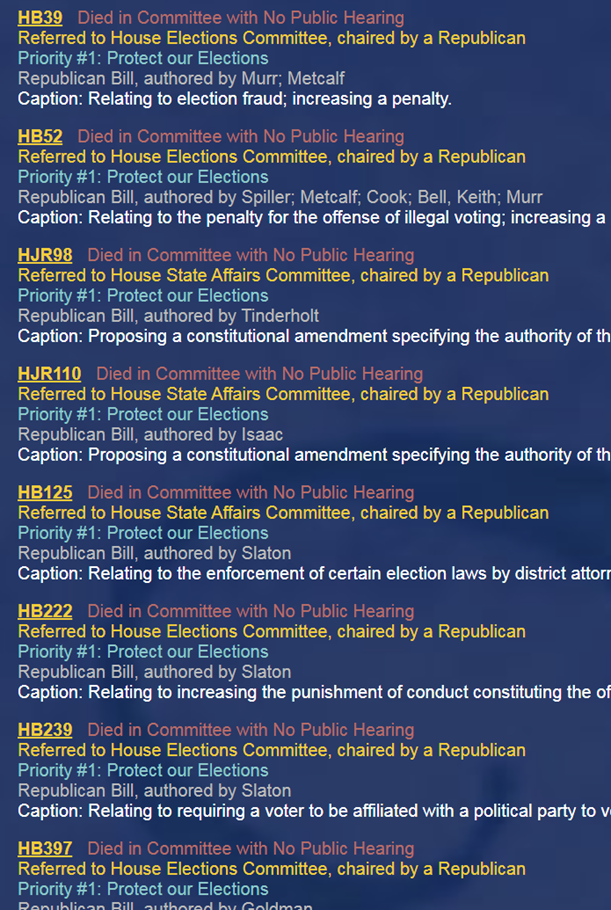
But here’s the back story: there were 216 priority bills. Only 13 passed. Election integrity, border security, banning Democrat chairs… these got no real traction during regular session.
Most priority bills die before they get to the floor for a vote. Granted, some are companion bills, meaning that they have the same language or try to do the same thing. But look at this screenshot for election integrity bills: