BREAKING NEWS — Call for Forensic Audit of Smith County

BREAKING NEWS — Call for Forensic Audit of Smith County

BREAKING NEWS — Grassroots America Calls for Forensic Audit of Smith County!

We’ve almost hit the one-year mark on our tedious investigation into unfinished county road bond projects (years behind schedule) — the deeper we dig, the more their receipts don’t add up!

Numerous attempts to get answers from County Judge Neal Franklin and the two longest serving Commissioners have failed. We’ve been waiting for a plan since March. Commissioner Drewry is the lone voice asking questions.

Enough is enough! We are determined to get truth and justice for Smith County taxpayers.

On 11/25/25, we notified the Council of District Judges and the County Auditor that we are requesting a forensic and compliance audit of road bond projects, the courthouse/parking garage bond funds, ARPA funds (COVID federal stimulus), the Employee Health Insurance Fund, and unexplained variances in fund balances.

The District Judges and County Auditor have the constitutional and statutory authority to compel the County Judge and Commissioners to comply.  We hope it won’t come to that, but we are prepared to file a Petition for a Writ of Mandamus with a Smith County District Judge against the County Judge and Commissioners.

On 11/25/25, we notified County Judge Neal Franklin and Commissioners Drewry, Moore, Herod, and Caraway of our forensic audit request.  We also requested they take these necessary actions immediately to protect taxpayers:

  1. full cooperation with County Auditor Karin Smith
  2. cease plans to purchase more property that drain funds needed for county roads – a much higher priority
  3. cease planning for the reported light rail project that will drain funds needed for county roads – a much higher priority
  4. cease any new economic development plans (including downtown) that divert/drain funds needed for county
  5. freeze spending from the Contingency Fund until the audit has been completed
  6. order a moratorium on accepting any more roads/streets into the county maintenance inventory until the Commissioners Court
    • a) votes on a detailed plan, budget, and timeline to finish the promised road bond projects and
    • b) votes on a detailed plan, budget, and timeline to conduct a pavement assessment of county roads. The last assessment of Smith County roads was ten years ago and was a five-year plan.

The next Commissioners Court meeting is at 9:30 AM, Tues. Dec. 9, Smith County Annex Building, 200 E. Ferguson St, Tyler.  We’ll be there!

Request for Cooperation Relating to Our Recommended Forensic and Compliance Audit of Smith County Financial Records and Associated Reports

Request for Cooperation Relating to Our Recommended Forensic and Compliance Audit of Smith County Financial Records and Associated Reports

November 25, 2025

Smith County Commissioners Court
County Judge Neal Franklin
County Commissioner Christina Drewry, Precinct One
County Commissioner John Moore, Precinct Two
County Commissioner J. Scott Herod, Precinct Three
County Commissioner Ralph Caraway, Sr., Precinct Four

Electronic Mail Delivery: Request for Cooperation Relating to Our Recommended Forensic and Compliance Audit of Smith County Financial Records and Associated Reports Led by Smith County Auditor Karin Smith

County Judge Franklin and County Commissioners:

You were emailed a copy of our request submitted today to the Council of District Judges and County Auditor Karin Smith.

As a follow up to that letter, please consider this communication as our formal request for

1) full cooperation with County Auditor Karin Smith

2) cessation of any plans to purchase more property that will drain funds needed for county roads – a much higher priority

3) cessation of the reported light rail project that will drain funds needed for county roads – a much higher priority

4) cessation of any new economic development plans that drain funds needed for county roads

5) the freezing of withdrawals from Contingency until the audit has been completed

6) a moratorium on accepting any more roads/streets into the county maintenance inventory until the Commissioners Court a) votes on a detailed plan, budget, and timeline to finish the promised road bond projects and b) votes on a detailed plan, budget, and timeline to conduct a pavement assessment of county roads. Atkins Engineering completed the last assessment of Smith County roads ten years ago and it was a five-year plan!

Thank you for your attention to this serious matter,

JoAnn Fleming

JoAnn Fleming, Executive Director
(903) 360-2858

JoAnn Fleming

Tom Fabry, Board member; Chair, Government Watchdog Committee
(817) 721-6701

Request for Forensic and Compliance Audit of Smith County Financial Records and Associated Reports

Request for Forensic and Compliance Audit of Smith County Financial Records and Associated Reports

Smith County Council of District Judges
The Honorable, Robert Wilson, Local Administrative District Judge; 321st District Court
The Honorable Kerry L. Russell, Judge of the 7th District Court
The Honorable Austin Reeve Jackson, Judge of the 114th District Court
The Honorable Debby Gunter, Judge of the 241st District Court
The Honorable Taylor Heaton, 475th District Court

Smith County Auditor Karin Smith

Electronic Mail Delivery: Request for Forensic and Compliance Audit of Smith County Financial Records and Associated Reports

November 25, 2025

Honorable District Judges and Auditor Smith:

As previously shared and discussed with County Auditor Smith and some members of the Council of District Judges, our county’s financial and bond project-related records show troubling discrepancies that we have sought to reconcile for almost a year without resolution. Frankly, the deeper we dig, the more alarmed we become.

Discrepancies in fund balances and reports for bond-funded capital projects must be reconciled. In addition, staff actions that have never even been discussed in Commissioners Court – let alone authorized by an official vote of the Commissioners Court – present a troubling pattern.

In one example, we discovered a legal notice for a Request for Proposal (RFP) solicitation related to an Employee Health Care Clinic for a project never discussed or approved by the Commissioners Court. In May 2025, we delivered proof via a copy of the legal notice…

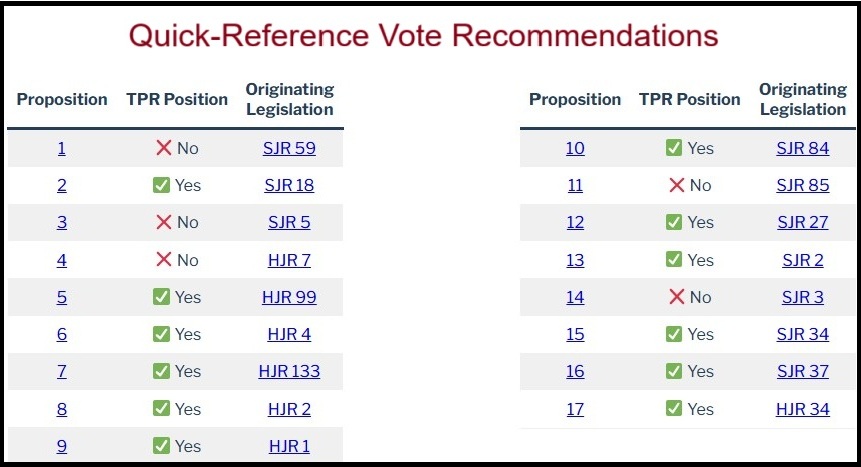
Voter Guide – Nov 4th Constitutional Amendments

Voter Guide – Nov 4th Constitutional Amendments

This is lengthy and detailed. It is important. How Texans vote shapes the future for generations.  As you witness the violent chaos unfolding, you must remember that EVERY election is important to beat back the enemies of Liberty – those who are easily seen and those cloaked in good intentions.  It is worth your time and effort to be an informed voter, esteeming what comes AFTER you far more important than any temporary personal benefit.

Protecting Liberty is no small matter.

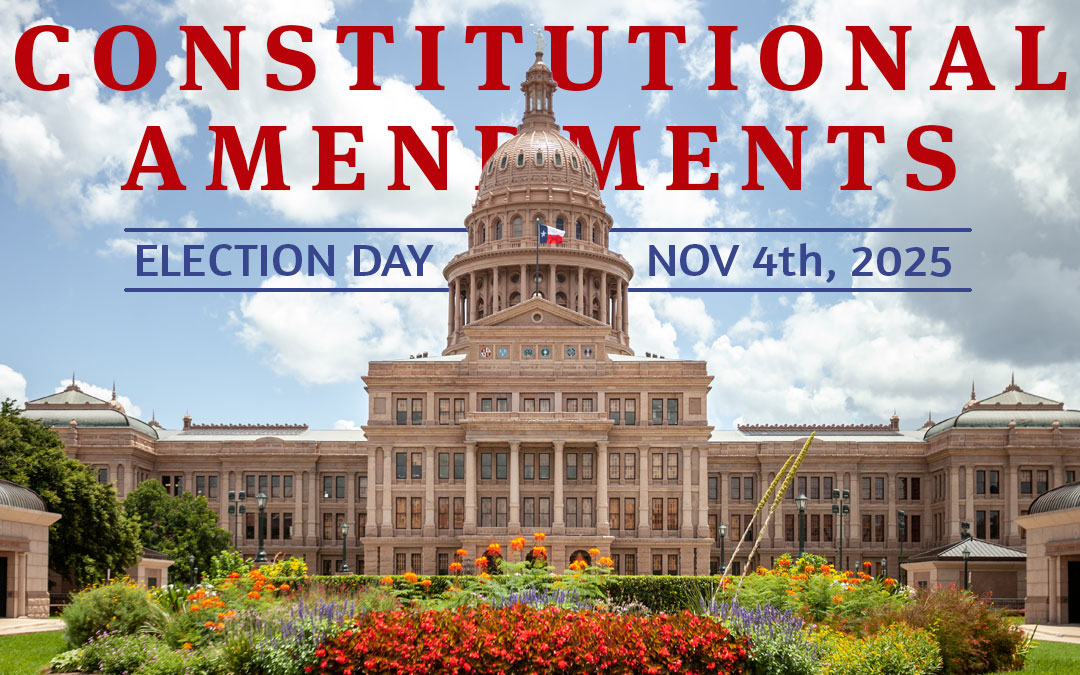
Texas Constitutional Amendment Election

 Election day: November 4th
Early voting:  Mon. 10/20 – Fri. 10/31/25 

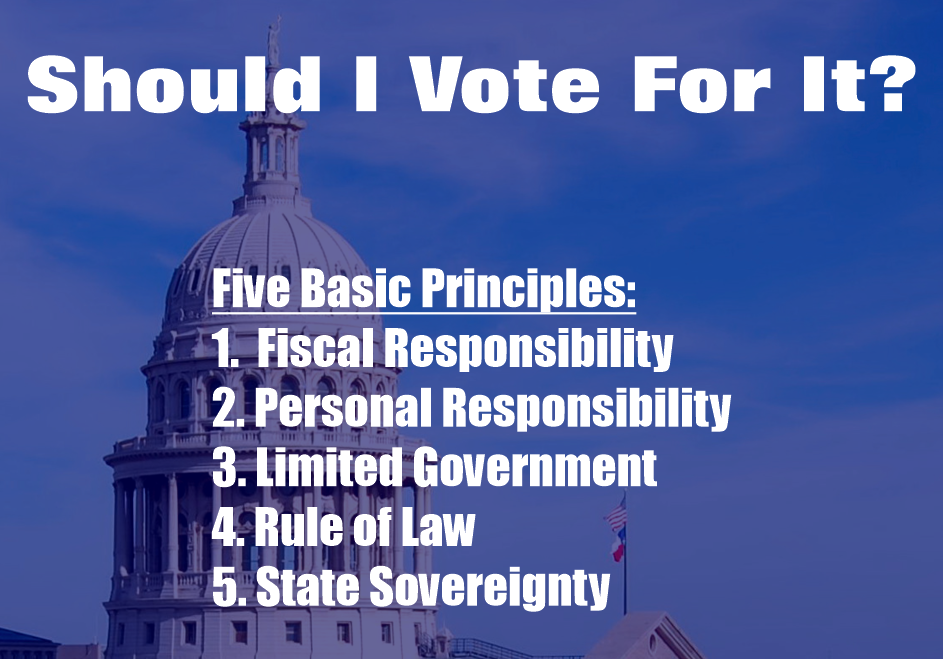
Do We Really Want Limited Gov’t?

Constitutional Amendment elections are “get out of jail free cards” for the state legislature and the exective branch.  Under the guise of “let the voters decide,” the ruling class and government-growing lobbyists convince legislators there’s a problem only government can solve. A constitutional amendment is the method they use to keep their fingerprints off the deed. 
 
In the last 25 years, we’ve seen the “let the people decide” tactic drive numerous constitutional amendments that damaged individual liberty and exponentially increased off-budget spending.  This is growing Texas government the sneaky way.
 
Constitutional amendments have become a tool that allows the Legislature to bypass statutory spending limits and constitutional constraints without passing comprehensive reform legislation. Box checked. Consequences ignored.
 
The architects of these amendments know that too few Texas voters pay any attention to amending the Texas Constitution. The average voter turnout for Texas constitutional amendment elections held in odd-numbered years between 1988 and 2023 was 11.1% of registered voters. This is significantly lower than the average turnout for general elections held in even-numbered years.
 

Keep this in mind – amending the Texas Constitution means that you believe the issue is worth saddling future generations with the consequences.

 
I urge you to be principled – not emotional – as you vote to amend our Texas Constitution.     

JoAnn Fleming

Ballot Guide & Vote Recommendations

Texas Policy Research | Jeramy Kitchen & Staff

Our Board of Directors reviewed the following ballot guides and recommendations from Jeramy Kitchen and his staff.  (Jeramy is a subject matter expert in fiscal policy for us.) These are solid recommendations based on Liberty Principles. We endorse them.  If you disagree, we don’t mind. This nation was founded upon vigorous, principled debate for future generations – not temporary convenience.

Proposition 1 

Ballot Language: “The constitutional amendment providing for the creation of the permanent technical institution infrastructure fund and the available workforce education fund to support the capital needs of educational programs offered by the Texas State Technical College System.”

Summary: This amendment would create two dedicated state funds to support infrastructure, land acquisition, and equipment for the Texas State Technical College System (TSTC), seeded with an initial $850 million in general revenue tax dollars. These funds would operate outside the normal state budget and legislative oversight. 

Texas Policy Research Recommendation:  Vote No 

Rationale: While expanding access to workforce education supports individual liberty and personal responsibility, embedding this funding in the Constitution undermines limited government and transparency. A statutory approach with normal budget oversight for fiscal accountability would be best.

Proposition 2 

Ballot Language: “The constitutional amendment prohibiting the imposition of a tax on the realized or unrealized capital gains of an individual, family, estate, or trust.”

Summary: This amendment would permanently prohibit the TX Legislature from imposing any tax on capital gains, whether realized or unrealized. Texas currently does not have such a tax; this functions as a safeguard to preserve the state’s existing low-tax structure.

Texas Policy Research Recommendation:  Vote Yes 

Rationale: This measure upholds individual liberty, private property rights, and free enterprise by protecting Texans from future financial intrusion and double taxation. It strengthens Texas’s commitment to limited government and long-term economic competitiveness.

Proposition 3 

Ballot Language: “The constitutional amendment requiring the denial of bail under certain circumstances to persons accused of certain offenses punishable as a felony.”

Summary: This amendment would authorize judges to deny bail to individuals charged with a list of serious felonies, such as murder, aggravated assault, and human trafficking, if the state proves by clear and convincing evidence that release would endanger the public or risk flight. It embeds mandatory bail denial for certain charges into the state constitution, with limited discretion for judges.

Texas Policy Research Recommendation:  Vote No 

Rationale: While aimed at improving public safety, this amendment undermines individual liberty by expanding pretrial detention without conviction and curtails judicial discretion. It creates a rigid, constitutionally enshrined mandate that risks overreach, erodes due process, and expands the scope of government authority without adequate safeguards.

[JoAnn Fleming added the following quote for additional context.]

Conservative judge and member of The Federalist Society, 114th District Court Judge Austin Reeve Jackson says, “Instead of giving judges the discretion that we want, and that a major majority of the public wants us to have – which is the discretion to deny bail for the most serious and violent offenders – it instead takes away our discretion and makes detention mandatory in cases where it is not always appropriate, while doing nothing to address the underlying harm of judges not having the authority to deny bail to violent and repeat offenders.

“This is yet another example of members of the legislature wanting to appear to do something about a problem without actually doing anything other than making it worse.  Instead of doing the hard work of crafting legislation that would give judges, prosecutors, and defense lawyers the ability to better identify and act to detain the worst of the worst offenders, while also making it easier to get people out of jail who don’t belong there, they instead craft something that will make things harder for the people doing the work in the trenches – which also poses a serious risk of significantly and unnecessarily increasing  detention costs to counties and their taxpayers.” 

Proposition 4 

Ballot Language: “The constitutional amendment dedicating a portion of the revenue derived from state sales and use taxes to the Texas Water Fund and to provide for the allocation and use of that revenue.” 

Summary: This amendment would divert up to $1 billion per year in existing sales tax revenue into a new Texas Water Fund to support water infrastructure projects. The funding would occur automatically each year, bypassing the normal legislative appropriations process, and would continue until 2035 unless extended by the legislature. 

Texas Policy Research Recommendation:  Vote No 

Rationale: While addressing water infrastructure is vital, this resolution undermines limited government and fiscal transparency by embedding automatic spending into the Constitution. It crowds out private-sector solutions, reduces future tax relief opportunities, and limits legislative accountability for long-term fiscal commitments.

Proposition 5 

Ballot Language: “Constitutional amendment authorizes the legislature to exempt from ad valorem taxation tangible personal property consisting of animal feed held by owner of the property for sale at retail.” 

Summary: This amendment gives the TX Legislature the authority to exempt animal feed held for retail sale from local property taxes. It does not require the exemption but permits future legislation to implement it, potentially correcting a tax inconsistency within the agricultural supply chain.

Texas Policy Research Recommendation:  Vote Yes 

Rationale: By reducing a targeted tax burden on agricultural retailers, this measure promotes free enterprise and strengthens private property rights. Though exemptions should be used cautiously, this amendment gives the Legislature flexibility to deliver fairer tax treatment without mandating new spending.

Proposition 6 

Ballot Language: “The constitutional amendment prohibiting the legislature from enacting a law imposing an occupation tax on certain entities that enter into transactions conveying securities or imposing a tax on certain securities transactions.”

Summary: This amendment would preemptively prohibit the Texas Legislature from imposing taxes on securities transactions or from creating new occupation taxes on registered financial market operators like brokers and exchanges. It aims to shield such investors and financial institutions from future taxation.

Texas Policy Research Recommendation:  Vote Yes 

Rationale: This measure affirms limited government, free enterprise, and private property rights by protecting investment activity from targeted taxation. It preserves Texas’s pro-business climate without fiscal downside, safeguarding both institutional and individual investors from government interference.

Proposition 7 

Ballot Language: “The constitutional amendment authorizing the legislature to provide for an exemption from ad valorem taxation of all or part of the market value of the residence homestead of the surviving spouse of a veteran who died as a result of a condition or disease that is presumed under federal law to have been service-connected.”

Summary: This amendment allows the Legislature to exempt the homestead of a surviving spouse of a veteran who died from a presumed service-connected condition. The exemption continues if the spouse remains unmarried and moves to a new qualifying homestead, carrying forward the previous tax relief.

Texas Policy Research Recommendation:  Vote Yes 

Rationale: This measure honors the sacrifices of military families and protects individual liberty and property rights. While such exemptions complicate the tax system, this narrowly targeted relief is justified. It should, however, be accompanied by broader property tax reform to maintain equity and simplicity.

Proposition 8 

Ballot Language: “The constitutional amendment to prohibit the legislature from imposing death taxes applicable to a decedent’s property or the transfer of an estate, inheritance, legacy, succession, or gift.”

Summary: Permanently prohibits the Texas Legislature from imposing estate, inheritance, or gift taxes. Texas does not currently levy such taxes; measure acts as a safeguard to prevent future reintroduction.

Texas Policy Research Recommendation:  Vote Yes 

Rationale: Proposition 8 reinforces private property rights, personal liberty, and limited government by ensuring Texans are free to transfer wealth without punitive taxation. It prevents future overreach, supports family financial stability, and protects generational business continuity without affecting current revenues.

Proposition 9 

Ballot Language: “The constitutional amendment to authorize the legislature to exempt from ad valorem taxation a portion of the market value of tangible personal property a person owns that is held or used for the production of income.”

Summary: This amendment would allow the Legislature to exempt up to $250,000 of the market value of income-generating personal property, such as business equipment or tools, from local property taxes. The exemption would ease the tax burden on small businesses and the self-employed.

Texas Policy Research Recommendation:  Vote Yes 

Rationale: Reducing taxes on productive assets, this measure promotes free enterprise, supports private property rights, aligns with limited gov’t principles; provides targeted relief to small businesses/entrepreneurs; encourages investment/job creation without direct costs on the state.

Proposition 10 

Ballot Language: “The constitutional amendment to authorize the legislature to provide for a temporary exemption from ad valorem taxation of the appraised value of an improvement to a residence homestead that is completely destroyed by a fire.”

Summary: This amendment would give the Legislature authority to provide a temporary property tax exemption for homesteads that are entirely destroyed by fire. The exemption would apply only to the value of the destroyed structure, not the land, and would be implemented through future legislation.

Texas Policy Research Recommendation:  Vote Yes 

Rationale: Proposition 10 upholds individual liberty and private property rights by ensuring homeowners are not taxed on homes that no longer exist. It allows narrowly tailored, compassionate relief without mandating new programs or increasing government scope, consistent with limited government principles.

Proposition 11 

Ballot Language: “The constitutional amendment authorizing the legislature to increase the amount of the exemption from ad valorem taxation by a school district of the market value of the residence homestead of a person who is elderly or disabled.”

Summary: Amendment authorizes the Legislature to raise the additional school property tax exemption for elderly/disabled homeowners from $10,000 to $60,000. The increased exemption would reduce school district taxes for qualifying individuals and be offset by state funds to maintain district funding levels.

Texas Policy Research Recommendation:  Vote No 

Rationale: Compassionate in intent, this shifts the tax burden onto younger and non-exempt Texans, expands state spending commitments without reform, erodes tax equity. True relief should come through comprehensive reform—not piecemeal exemptions that weaken limited government and fiscal discipline.

Proposition 12 

Ballot Language: “The constitutional amendment regarding the membership of the State Commission on Judicial Conduct, the membership of the tribunal to review the commission’s recommendations, and the authority of the commission, the tribunal, and the Texas Supreme Court to more effectively sanction judges and justices for judicial misconduct.”

Summary: This amendment would expand and restructure the State Commission on Judicial Conduct (SCJC), increasing its membership and public representation, while enhancing its ability to issue public sanctions against judges. It also introduces new powers, including the authority to suspend judges upon indictment for certain crimes.

Texas Policy Research Recommendation:  Vote Yes 

Rationale: Proposition 12 promotes transparency, public accountability, and personal responsibility within the judiciary by broadening citizen oversight and strengthening enforcement of judicial ethics.

Proposition 13 

Ballot Language: “The constitutional amendment to increase the amount of the exemption of residence homesteads from ad valorem taxation by a school district from $100,000 to $140,000.”

Summary: This amendment would raise the school district property tax exemption on homesteads from $100,000 to $140,000, reducing taxable home values and offering tax relief to homeowners. The state would reimburse school districts for the resulting loss in revenue. 

Texas Policy Research Recommendation:  Vote Yes

(with reservations) 

Rationale: While this amendment provides short-term relief for homeowners, it does so by shifting the burden onto renters, small businesses, and non-exempt property owners. Broader tax reform, such as permanent M&O rate compression, would deliver more equitable and lasting relief across all Texans.

Proposition 14 

Ballot Language: “The constitutional amendment providing for the establishment of the Dementia Prevention and Research Institute of Texas, establishing the Dementia Prevention and Research Fund to provide money for research on and prevention and treatment of dementia, Alzheimer’s disease, Parkinson’s disease, and related disorders in this state, and transferring to that fund $3 billion from state general revenue.”

Summary: This amendment would create a new state-run medical research institute and permanently dedicate $3 billion from general revenue, plus up to $300 million annually, for research and infrastructure related to dementia and other neurodegenerative diseases. The fund would exist outside the state’s regular spending cap, making the way for increased spending above the spending cap for each legislative session.

Texas Policy Research Recommendation:  Vote No 

Rationale: While well-intentioned, this amendment expands the scope and permanence of government by embedding medical research funding into the Constitution. It bypasses the appropriations process, undermines limited government, and risks crowding out private innovation in healthcare without clear fiscal safeguards or performance accountability.

Proposition 15 

Ballot Language: “The constitutional amendment affirming that parents are the primary decision makers for their children.”

Summary: This amendment would enshrine in the Texas Constitution the inherent right of parents to care for and make decisions about their children’s upbringing. It would restrict state or local government interference unless justified by a compelling government interest using the least restrictive means.

Texas Policy Research Recommendation:  Vote Yes 

Rationale: Proposition 15 affirms individual liberty, personal responsibility, and limited government by codifying parental rights and ensuring state action is narrowly constrained. It empowers families to guide their children’s upbringing without unwarranted interference from public institutions.

Proposition 16 

Ballot Language: “The constitutional amendment clarifying a voter must be a US citizen.”

Summary: This amendment would explicitly state in the Texas Constitution that only U.S. citizens may vote in Texas elections. While current law already limits voting to citizens, this measure codifies that restriction in the Constitution to prevent future legal or policy changes allowing non-citizen voting.

Texas Policy Research Recommendation:  Vote Yes 

Rationale: Proposition 16 affirms individual liberty and limited government by clearly tying voting rights to citizenship and civic responsibility. It acts as a constitutional safeguard with minimal fiscal impact, reinforcing electoral integrity and state sovereignty.

Proposition 17 

Ballot Language: “The constitutional amendment to authorize the legislature to provide for an exemption from ad valorem taxation of the amount of the market value of real property located in a county that borders the United Mexican States that arises from the installation or construction on the property of border security infrastructure and related improvements.”

Summary: This amendment allows the Legislature to exempt from property taxation any increase in value to land in TX border counties that results from the addition of border security infrastructure. It is a narrowly tailored measure meant to avoid penalizing landowners for voluntary security-related improvements.

Texas Policy Research Recommendation:  Vote Yes 

Rationale: Proposition 17 respects private property rights, individual liberty, and limited government by preventing tax penalties for landowners who choose to invest in border security. While exemptions should be used sparingly, this one is well-targeted and permissive, offering relief without expanding state programs or spending.

Expired Visas & Illegals – End Trucker Licensing

Expired Visas & Illegals – End Trucker Licensing

Americans should not have to worry about unqualified or illegal alien drivers operating 85,000-pound trucks on public roads.

IMMEDIATE RELEASE

CONTACTS:

Terri Hall, Founder/Executive Director
TURF & Texans for Toll-free Highways
(210) 275-0640

JoAnn Fleming, Executive Director
Grassroots America – We the People
(903) 360-2858

Three Texas grassroots organizations applaud Secretary Duffy's emergency action on commercial driver licensing

Call for stronger federal oversight of autonomous 18-wheelers due to national security concerns

(AUSTIN, TEXAS — October 6, 2025) — Texans Uniting for Reform and Freedom(TURF), Texans for Toll-free Highways (TTH), and Grassroots America – We the People (GAWTP) are committed to protecting the safety and sovereignty of Texas roads and highways and announce their strong support of U.S. Transportation Secretary Sean Duffy’s emergency actions announced Friday, September 26, 2025. The new rule targeting the abuse of non-domiciled Commercial Driver’s Licenses (CDLs) is a bold and necessary move that prioritizes the lives and safety of American citizens.

The Department of Transportation’s decision to crack down on dangerously lax licensing procedures is long overdue. The groups share Duffy’s outrage over the Federal Motor Carrier Safety Administration’s (FMCSA) review of state issuances of both CDLs and commercial learner’s permits (CLP) that found substantial non-compliance of drivers who live in a state or country with different standards than the state where they are licensed. 

Texas is one of six states in systematic non-compliance for issuing non-domiciled CDLs along with California, Colorado, Pennsylvania, South Dakota, and Washington. 

“American families should not have to worry about unqualified or unlawfully-present individuals operating 85,000-pound trucks on public roads. Texans are fed-up with policies that put political correctness over basic public safety,” noted TURF Founder and Executive Director Terri Hall

“We applaud Secretary Duffy and the Trump administration for taking decisive action and demanding accountability from rogue states. Dangerous drivers with expired visas or no legal status should never have been licensed to begin with. This rule is a victory for safety, common sense, and the rule of law,” remarked JoAnn Fleming, Executive Director of Grassroots America. 

History of opposing dangerous trucking policies

TURF has been a vocal opponent of the cross-border trucking program since its implementation under NAFTA. Under both Democrat and Republican administrations, TURF strongly pushed back against policies that allowed unsafe or inadequately vetted foreign drivers to operate in the U.S. Despite years of advocacy, federal inaction persisted—until now.

“We have been sounding the alarm for decades,” Hall added. “We are pleased to finally see the Trump administration do something about it. This emergency rule is a long-overdue step in the right direction.”


Texas Must Lead by Example

While Texas has long been a leader in transportation, these grassroots groups believe this revelation should be a wake-up call. 

“There is no room for error when it comes to public safety on our highways,” Hall continued. “Texas must show it is part of the solution—not part of the problem. We’re relieved DPS announced last week that it will no longer be issuing CDLs to non-citizens, we will be closely monitoring the situation in Texas until we are confident that all trucking companies are following the law and that unsafe licenses are revoked.”


Groups urge federal action on AV trucks

In addition to supporting this critical regulatory reform, the groups also call on the federal government to take immediate and bold action regarding the proliferation of Level 4 and Level 5 Autonomous Vehicles (AVs) (primarily commercial trucks) — vehicles operating with no human driver onboard.

TURF has long warned that fully driverless commercial trucks represent a grave national security threat, as well as a ticking time bomb for public safety:

  • A completely driverless 18-wheeler could be weaponized with ease.
  • Hacking by hostile actors (or nations) or technological malfunctionscould be weaponized and used to crash into buildings, critical infrastructure, cause catastrophic multi-vehicle pile-ups, or block major roadways.
  • These vehicles remove human judgment from high-speed, high-stakes traffic environments.
  • The public has had no voice or consent in allowing these machines on our roads.

“We are deeply concerned that while we work to close dangerous loopholes around foreign CDL holders, Big Tech is quietly replacing them with driverless trucks that are just as, if not more, dangerous,” added Hall. “If a human driver can cause a fatal crash due to negligence, what happens when there’s no driver and the system fails or gets hacked? We’ve seen the headlines — it’s not a matter of if, but when” (emphasis ours).

The groups urge President Trump to press Congress to take immediate legislative action to protect all Americans from the dangers of commercial AVs, and also call on the U.S. Department of Transportation to:

  • Place an immediate moratorium on the operation of fully autonomous commercial vehicles (Levels 4 and 5).
  • Conduct a national security assessment on the potential weaponization of autonomous trucks.
  • Require public hearings and state-level input before these technologies are authorized for widespread use.
  • Demand strict cybersecurity standards for any AI-operated vehicle used in interstate commerce.
  • Require a human driver to be present in every AV.

Secretary Duffy’s emergency action is a pivotal step in restoring integrity and safety to our roads. TURF urges continued vigilance and transparency—not just for CDL licensing, but for the growing and largely unregulated frontier of autonomous trucking. American lives, infrastructure, and national security must not be sacrificed in the name of automation or political expediency.

# # #